Enjoy the Silence Electric Boat Show in Gothenburg, Sweden

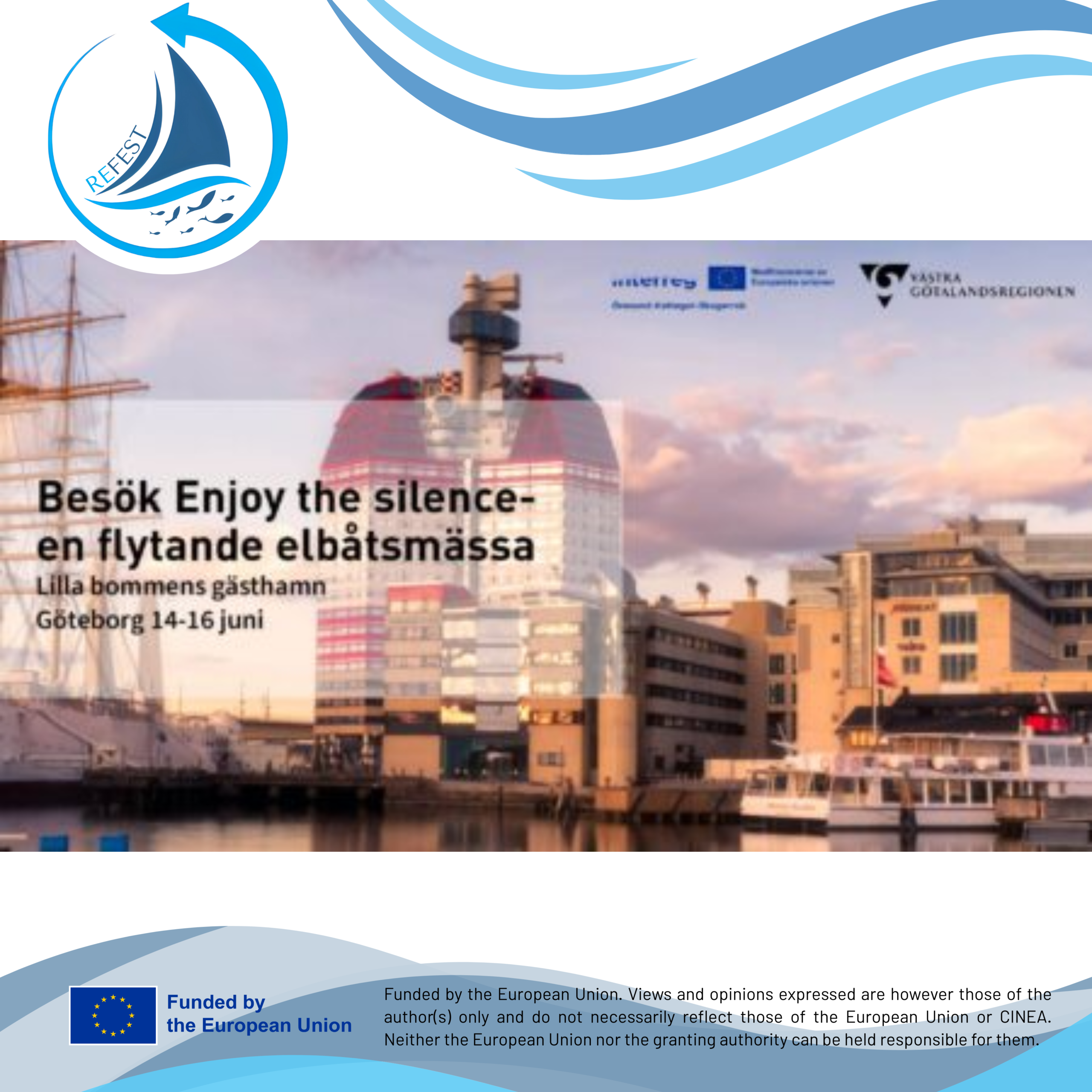
The REFEST EU Project will participate in the Enjoy the Silence Electric Boat Show, taking place in Gothenburg, Sweden, from 14 to 16 June 2025.

Enjoy the Silence is Sweden’s first floating fair dedicated exclusively to electric boats and electric watercraft. The event will bring together companies, innovators, technology providers and maritime stakeholders to showcase the latest developments in sustainable marine propulsion and zero-emission boating solutions.

The exhibition will provide an important opportunity to explore cutting-edge technologies supporting the transition towards cleaner and quieter maritime mobility. Among the innovations presented, the event will feature the YANMAR E-Saildrive, an award-winning electric propulsion system designed to deliver smooth, efficient and zero-emission performance for sailing applications.
Representatives from RISE Research Institutes of Sweden will attend the event on behalf of REFEST, contributing to the exchange of knowledge on sustainable propulsion technologies and their potential relevance for the decarbonisation of small fishing vessels.

REFEST’s participation in the Enjoy the Silence Electric Boat Show will represent a valuable opportunity to engage with stakeholders working on electric marine solutions, explore possible synergies with innovative propulsion technologies, and strengthen the project’s contribution to reducing fuel consumption and greenhouse gas emissions in the fisheries sector.
Net Zero Tech Barcelona 2025

REFEST will participate in Net Zero Tech Barcelona 2025, taking place on 4-5 June 2025 at La Farga Exhibition Centre in L’Hospitalet de Llobregat, Barcelona, Spain.

Organised by Five Continents Exhibitions, Net Zero Tech Barcelona 2025 is addressed to professionals and companies from the energy sector, public administrations committed to the energy transition, startups and SMEs working on sustainability, researchers and academics in the field of decarbonisation, and investors interested in clean and sustainable technologies.

The event will contribute to the fight against climate change by promoting industrial decarbonisation and the energy transition, with a strong focus on energy efficiency, electrification through renewable energy, green hydrogen, biomethane, CO₂ capture and reuse technologies, digitalisation, and other innovative solutions for low-carbon industries.

The programme will be structured around five key areas: Efficient Tech, dedicated to energy efficiency projects; Case Studies Tech, presenting successful examples of industrial decarbonisation; H2Tech, focused on green hydrogen production, storage and use; Biogas Tech, addressing the potential of biogas and biomethane in Spain’s energy transition; and Green-e Tech, exploring renewable-based electrification in industrial and commercial sectors.

Representatives from AIMPLAS will attend the event on behalf of REFEST. Participants interested in learning more about the project will have the opportunity to collect a REFEST brochure, ask questions directly to the AIMPLAS colleagues, and discover how the project is contributing to the reduction of fuel consumption and greenhouse gas emissions in the fisheries sector.

Awareness campaign 3 – Behind REFEST Mission: The impact of fishing activities on environment (MIR)

In the past, fishing was the most widespread human exploitative activity in the marine environment. However, global fisheries trends indicate an overall decline in the productivity of the world’s fishery resources. This is one of the reasons why the proportion of sustainably harvested stocks in Europe has increased significantly in recent years. Over the last two decades, fishing effort in Europe has been progressively reduced in terms of the number of vessels, engine power, and tonnage. Nonetheless, pressure on fish stocks remains high. Therefore, it is crucial to minimize the negative impacts of fishing on target species, communities, benthic ecosystems, and habitats. The extent of fisheries’ environmental impacts depends on various factors. These impacts are complex, often difficult to measure, and vary between fisheries.

The first and most obvious negative impact of fisheries is the mortality imposed on target species and the reduction of their natural abundance. A species’ vulnerability to fishing depends on the type of fishing gear used, the species’ morphometric traits, behavior, and life-history characteristics. In heavily fished populations, dominant patterns such as truncated size structures, biased sex ratios, altered genetic structures, shifts in growth, maturity and spawning schedules, and sometimes reduced relative fecundity have been observed. These changes lower the overall reproductive potential of the population. In mixed fisheries, similar responses may occur across all targeted species. In cases of improper resource management, fisheries may develop excessive capacity, leading to overfishing.

Fishing can also negatively affect non-target and/or rare and sensitive species caught as unintended bycatch. The survival rate of discarded fish is typically very low, which was one of the reasons behind the implementation of the discard ban. Bycatch-induced mortality can indirectly affect ecosystems and habitats by disrupting food web interactions. At the community level, fishing alters food web structures, impacting various aspects of biodiversity. High biodiversity supports ecosystem stability and resilience. While spatial biodiversity is primarily governed by biogeographic factors, fishing influences species dominance by altering the abundance of target species. Globally, there are numerous reports documenting the impacts of fishing on benthic ecosystems and habitats, as well as on sensitive and rare non-target species, including marine mammals, birds, and turtles. Bycatch is also a global threat to highly migratory, long-lived marine taxa such as turtles, seabirds, marine mammals, and sharks.

Furthermore, fisheries can have both direct and indirect effects on benthic ecosystems. Direct impacts result from physical disturbances to the seafloor, which can alter seabed structure, remove organisms, cause accidental mortality or injury, and affect sediment biochemistry. Indirectly, the removal of fish and/or benthic species can alter food web structures and thus affect ecosystem functioning.

Another aspect of the environmental impact of fisheries is underwater noise produced by operating ships and vessels. Large commercial vessels generate relatively loud, predominantly low-frequency sounds. Each vessel has a unique acoustic signature, although these signatures may vary depending on speed, load, operational mode, and any implemented sound-reduction measures. Anthropogenic underwater noise is known to have a wide range of direct, indirect, and cumulative effects on marine species, from exposures with no adverse impact to significant behavioral disturbances, hearing loss, and even mortality.

Marine fouling affects most man-made surfaces temporarily or permanently submerged in seawater, resulting in substantial economic costs. The most common solution to prevent fouling is to coat surfaces with antifouling paints containing toxic compounds. During vessel operation, these paints flake off, releasing harmful substances into the environment. Many of these compounds have undesirable effects on non-target species, including commercially important organisms.

Accidental fuel leaks also pose a serious threat to the environment. Furthermore, the risk of highly flammable marine oil leaks increases operational hazards for fishing vessels.

Fishing nets have a limited lifespan and are considered waste once they are worn or irreparably damaged. During fishing operations, nets can be accidentally lost or damaged and remain on the seafloor – these are known as ghost nets. If not removed, ghost gear poses a serious threat to the marine environment and wildlife, including seabirds, marine mammals, and fish. The threat arises both from the continued ability of such gear to entrap organisms and from the pollutants released during its degradation. Over decades to centuries, lost fishing nets and ropes shed microplastic fibers into the marine environment.

Cover image by Yiran Ding on Unsplash

Meet H2-SEAS: Coastal Fishing Vessels Powered by Zero Emission Hydrogen Fuel Cells

REFEST is pleased to welcome H2-SEAS as a sister project committed to advancing the decarbonisation of small-scale coastal fishing fleets through zero-emission hydrogen technologies.

Funded by the European Union, H2-SEAS is developing a fully integrated hydrogen-electric fishing vessel that combines increased energy efficiency with environmental sustainability. With zero emissions and low noise pollution, this prototype is designed to operate under real marine conditions and showcase the viability of hydrogen fuel cells in small-scale fisheries.

The project is led by Riga Technical University (RTU) in collaboration with key partners such as hydrogen systems integrator Genevos, Latvian shipyard A2Z, SEI Tallinn, and Vidzeme University of Applied Sciences. Together, they are bridging advanced engineering with policy research and environmental monitoring to accelerate clean energy adoption in the maritime sector.

H2-SEAS and REFEST share a vision of more sustainable, resilient fisheries—supporting innovation that aligns with the European Green Deal and the EU Biodiversity Strategy for 2030.

Learn more: https://h2-seas.eu/

Introducing SEAGLOW: a sister project driving sustainable innovation in small-scale fisheries

REFEST is proud to introduce its sister project, SEAGLOWSustainable Energy Applications for Green and Low-impact Operation of small-scale fishing boats in the Baltic and North Sea basins. This EU-funded initiative is committed to demonstrating the impact and potential of innovative technologies aimed at reducing fossil fuel consumption and greenhouse gas emissions in small-scale fisheries.

Through five cutting-edge technological applications – including hybrid electric drivetrains, methanol-powered engines, durable anti-fouling polymer-based coatings, behaviour-influencing low-cost sensors, and technology combinations – SEAGLOW collects sensor data from case vessels to assess environmental impact over time and optimize performance.

Led by the North Denmark EU Office, the project brings together a consortium of 16 partners from the EU, Norway, and Thailand, uniting experts in marine energy, technology providers, researchers, policy makers, and fishing associations. Together, they work toward solutions that not only support EU sustainability goals but also improve the livelihoods of small-scale fishers and contribute to the restoration of marine ecosystems.

SEAGLOW and REFEST share a common mission: accelerating the transition towards low-impact and climate-resilient fisheries.

Know more at https://seaglow.eu

NetZero Energy & H2POLAND 2025

The REFEST Project will participate in the NetZero Energy & H2POLAND 2025, taking place in Poznań, Poland, from 8 to 10 April 2025.

NetZero Energy & H2POLAND 2025 is one of the largest business events in Central and Eastern Europe dedicated to energy transition and industrial decarbonisation. The event brings together industry representatives, experts, market leaders, decision-makers, innovators, the scientific community and public authorities, providing a strategic platform for dialogue on the future of energy and industry.

The 2025 edition will address key areas of the energy transformation, including the modernisation and digitalisation of transmission networks, the development of nuclear energy, including Small Modular Reactors, and its synergy with renewable energy sources, energy storage technologies, the role of gas and biomethane, low-emission heating, Net Zero strategies through CCS/CCU, the availability and recycling of strategic raw materials, as well as the application of artificial intelligence, cybersecurity and the protection of critical infrastructure.

Representatives from Morski Instytut Rybacki – Państwowy Instytut Badawczy (MIR-PIB) will attend the event on behalf of REFEST, contributing to the exchange of knowledge and perspectives on sustainable energy solutions and the decarbonisation of maritime activities.

REFEST’s participation in such industrial event will represent an important opportunity to engage with energy-sector stakeholders, explore synergies with ongoing decarbonisation initiatives, and highlight the project’s contribution to reducing fuel consumption and greenhouse gas emissions in the fisheries sector.
Fourth Mission Arena in Sopot, Poland

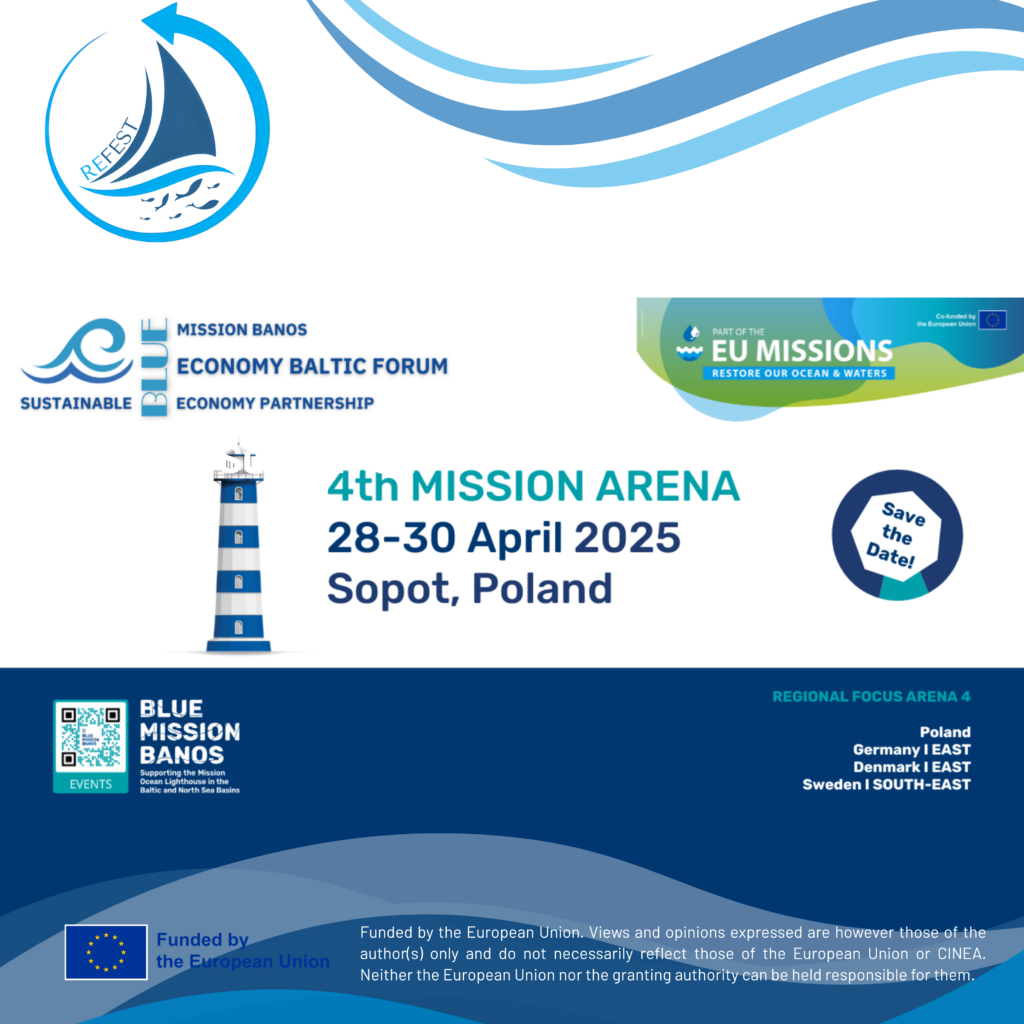
The REFEST Project will participate in the Fourth Mission Arena, taking place in Sopot, Poland, on 28-29 April 2025, in conjunction with the Blue Economy Baltic Forum and the Polish EU Council Presidency.

The event, co-organised by BlueMissionBANOS and the Sustainable Blue Economy Partnership, will bring together stakeholders from across the Baltic and North Sea regions to discuss key challenges and opportunities for the sustainable blue economy. This fourth Mission Arena will focus on the region covering Poland, Eastern Germany and Denmark, and South-Eastern Sweden.

Over one and a half days, participants will address some of the most pressing blue economy issues facing the region, including shipping and ports, maritime security, sustainable food production, and the broader transition towards more sustainable maritime activities. The event will also contribute to the co-creation of a regional roadmap supporting the achievement of the objectives of the EU Mission “Restore our Ocean and Waters”.

Representatives from Morski Instytut Rybacki – Państwowy Instytut Badawczy (MIR-PIB) will attend the event on behalf of REFEST, contributing to the discussions and presenting the project’s perspective on the decarbonisation of the fisheries sector.

REFEST’s participation will represent an important opportunity to strengthen dialogue with regional stakeholders, share knowledge on innovative low-carbon solutions for fishing vessels, and support the wider transformation of the maritime sector towards more sustainable and energy-efficient practices.

Awareness Campaign – BEHIND REFEST MISSION: CO2 and other pollutant emissions affecting marine and fishing environment and REFEST pro-ject mission to minimize the problem

The REFEST online campaign, under the motto “Planting Awareness,” kicks off with “BEHIND THE REFEST MISSION”, focusing on the Problem Statement. This campaign will introduce the challenges we face before presenting the REFEST solutions in upcoming campaigns. The first campaign will span 5 months, covering 5 key topics and pursuing one main goal: to raise awareness about the environmental, acoustic, and energy pollution caused by traditional fishing practices, while shedding light on the context in which REFEST operates. Learn more about it int he dedicated news!

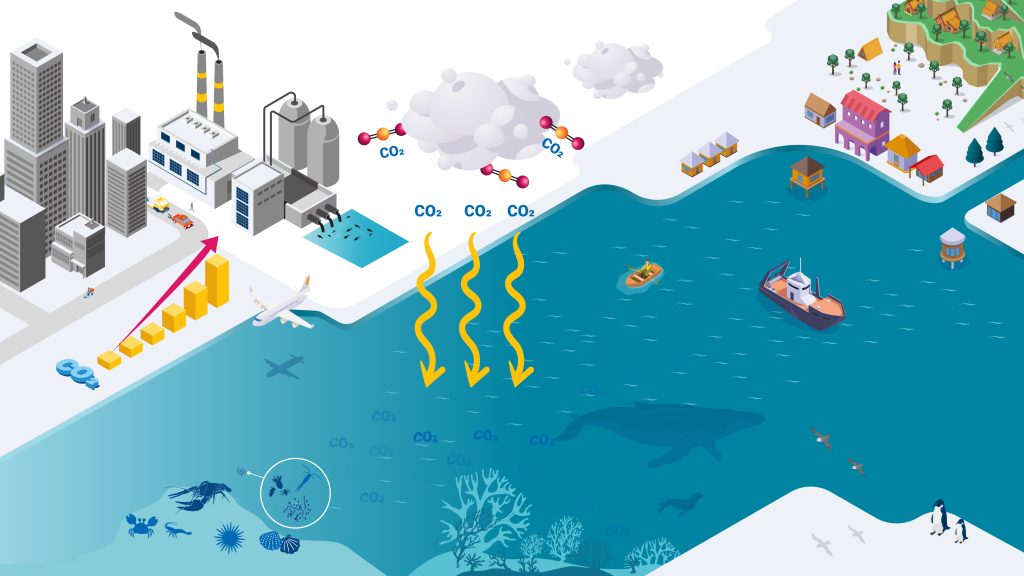
Image – Ph. IAEA (https://www.iaea.org/bulletin/how-carbon-emissions-acidify-our-ocean)

2° TOPIC: REDUCTION OF CO2 AND OTHER POLLUTANT EMISSIONS

The second topic of the Behind REFEST Mission campaign is focused on thereduction of CO2 and other pollutant emissions and it is explained by the Project Coordinator, Klaipeda University, with the Project Partner, MORSKI INSTYTUT RYBACKI – PAŃSTWOWY INSTYTUT BADAWCZY (MIR).  

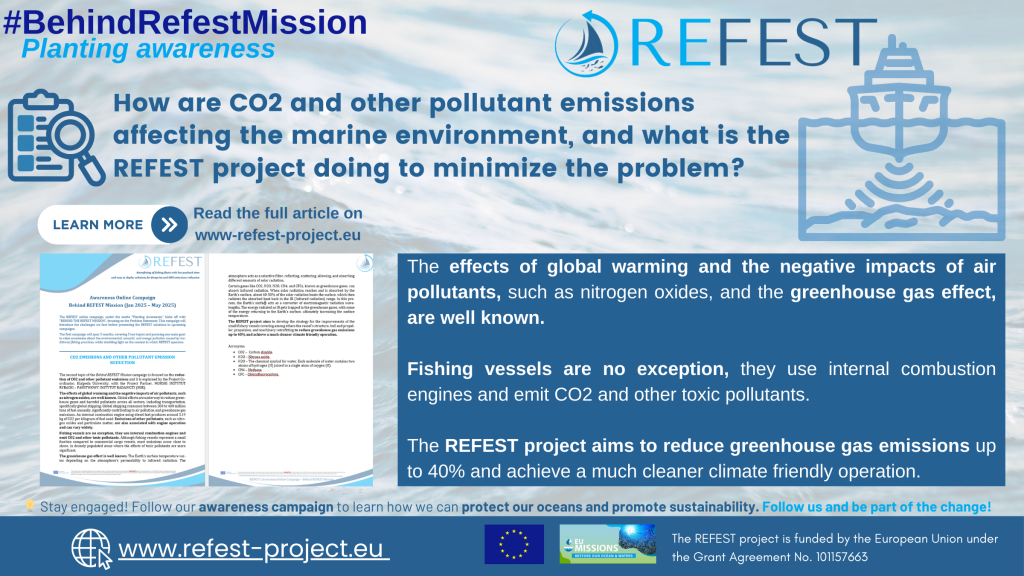
The effects of global warming and the negative impacts of air pollutants, such as nitrogen oxides, are well known. Global efforts are underway to reduce greenhouse gases and harmful pollutants across all sectors, including transportation, specifically global shipping. Global shipping consumes between 200 to 400 million tons of fuel annually, significantly contributing to air pollution and greenhouse gas emissions. An internal combustion engine using diesel fuel produces around 3.19 kg of CO2 per kilogram of fuel used. Emissions of other pollutants, such as nitrogen oxides and particulate matter, are also associated with engine operation and can vary widely.  

Fishing vessels are no exception, they use internal combustion engines and emit CO2 and other toxic pollutants. Although fishing vessels represent a small fraction compared to commercial cargo vessels, most emissions occur close to shore, in densely populated areas where the effects of toxic pollutants are more significant.   

The greenhouse gas effect is well known. The Earth’s surface temperature varies depending on the atmosphere’s permeability to infrared radiation. The atmosphere acts as a selective filter, reflecting, scattering, allowing, and absorbing different amounts of solar radiation.  

Certain gases like CO2, N2O, H2O, CH4, and CFCs, known as greenhouse gases, can absorb infrared radiation. When solar radiation reaches and is absorbed by the Earth’s surface, about 40-50% of the solar radiation heats the surface, which then radiates the absorbed heat back in the IR (Infrared radiation) range. In this process, the Earth’s surface acts as a converter of electromagnetic radiation wavelengths. The energy radiated as IR gets trapped in the greenhouse gases, with some of the energy returning to the Earth’s surface, ultimately increasing the surface temperature.   

The REFEST project aims to develop the strategy for the improvements of the small fishery vessels covering among others the vessel’s structure, hull and propeller, propulsion, and machinery retrofitting to reduce greenhouse gas emissions up to 40% and achieve a much cleaner climate friendly operation.   

Acronyms:  

  • CO2 – Carbon dioxide   
  • N2O – Nitrous oxide  
  • H2O – The chemical symbol for water. Each molecule of water contains two atoms of hydrogen (H) joined to a single atom of oxygen (O)
  • CH4 – Methane 
  • CFC – Chlorofluorocarbon 

Download the full article from the ”Download‘ page.

Cover image by Nikldn on Unsplash

Awareness Campaign – BEHIND REFEST MISSION: Acoustic pollution affecting marine biodiversity and REFEST pro-ject mission to minimize the problem

REFEST: Planting Awareness for a Sustainable Future!

The REFEST online campaign, under the motto “Planting Awareness,” kicks off with “BEHIND THE REFEST MISSION”, focusing on the Problem Statement. This campaign will introduce the challenges we face before presenting the REFEST solutions in upcoming campaigns. The first campaign will span 5 months, covering 5 key topics and pursuing one main goal: to raise awareness about the environmental, acoustic, and energy pollution caused by traditional fishing practices, while shedding light on the context in which REFEST operates. Learn more about it int he dedicated news!

1° TOPIC: UNDERWATER NOISE POLLUTION REDUCTION

The first topic of the Behind REFEST Mission campaign is focused on the Acoustic pollution affecting marine biodiversity and it is explained by the Project Coordinator, Klaipeda University.

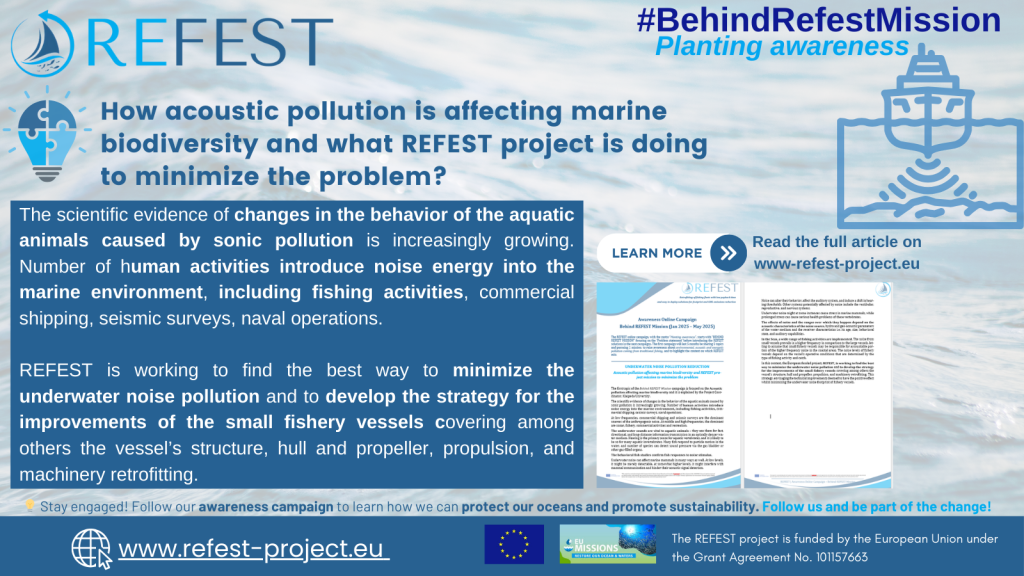
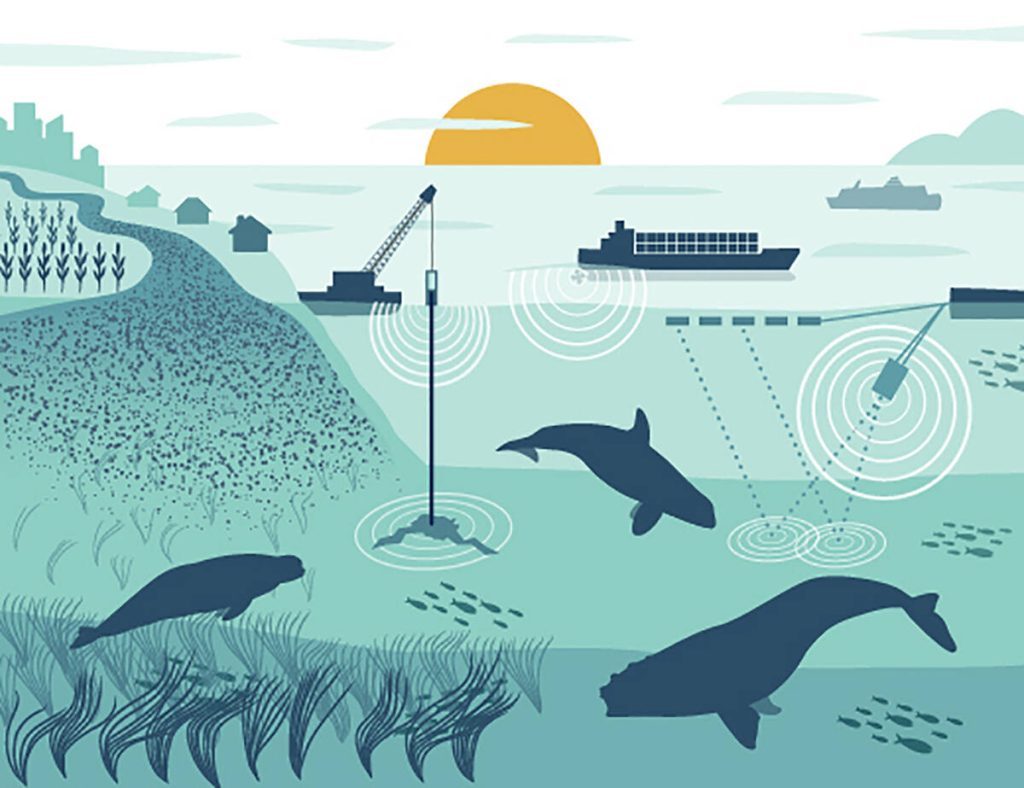
The scientific evidence of changes in the behavior of the aquatic animals caused by sonic pollution is increasingly growing. Number of human activities introduce noise energy into the marine environment, including fishing activities, commercial shipping, seismic surveys, naval operations.

At low frequencies, commercial shipping and seismic surveys are the dominant sources of the anthropogenic noise. At middle and high frequencies, the dominant are sonar, fishery, commercial activities and recreation. 

The underwater sounds are vital to aquatic animals – they use them for fast, directional, and long-distance information transmission in an optically denser water medium. Hearing is the primary sense for aquatic vertebrates, and it is likely to be so for many aquatic invertebrates. Many fish respond to particle motion in the water, and number of species can detect sound pressure via the gas bladder or other gas-filled organs.

The behavioral fish studies confirm fish responses to noise stimulus.

Underwater noise can affect marine mammals in many ways as well. At low levels, it might be merely detectable, at somewhat higher levels, it might interfere with mammal communication and hinder their acoustic signal detection.

Noise can alter their behavior, affect the auditory system, and induce a shift in hearing thresholds. Other systems potentially affected by noise include the vestibular, reproductive, and nervous systems.

Underwater noise might at some instances cause stress in marine mammals, while prolonged stress can cause serious health problems of these vertebrates.

The effects of noise and the ranges over which they happen depend on the acoustic characteristics of the noise source, hydro and geo-acoustic parameters of the water medium and the receiver characteristics i.e. its age, size, behavioral state, and auditory capabilities. 

In the Seas, a wide range of fishing activities are implemented. The noise from small vessels prevails in a higher frequency in comparison to the large vessels, letting to assume that small fishery vessels may be responsible for accountable portion of the higher frequency noise in the coastal areas. The noise levels of fishery vessels depend on the vessel’s operative conditions that are determined by the type of fishing activity and catch.  

In this context, the European funded project, REFEST, is working to find the best way to minimize the underwater noise pollution and to develop the strategy for the improvements of the small fishery vessels covering among others the vessel’s structure, hull and propeller, propulsion, and machinery retrofitting. This strategy, envisaging the technical improvements deemed to have the positive effect whilst minimising the underwater noise footprint of fishery vessels. 

Download the full article from the ”Download‘ page.

Cover image by Hal Gatewood on Unsplash