

REFEST: Planting Awareness for a Sustainable Future!
The REFEST online campaign, under the motto “Planting Awareness,” kicks off with “BEHIND THE REFEST MISSION”, focusing on the Problem Statement. This campaign will introduce the challenges we face before presenting the REFEST solutions in upcoming campaigns. The first campaign will span 5 months, covering 5 key topics and pursuing one main goal: to raise awareness about the environmental, acoustic, and energy pollution caused by traditional fishing practices, while shedding light on the context in which REFEST operates. Learn more about it int he dedicated news!
1° TOPIC: UNDERWATER NOISE POLLUTION REDUCTION
The first topic of the Behind REFEST Mission campaign is focused on the Acoustic pollution affecting marine biodiversity and it is explained by the Project Coordinator, Klaipeda University.
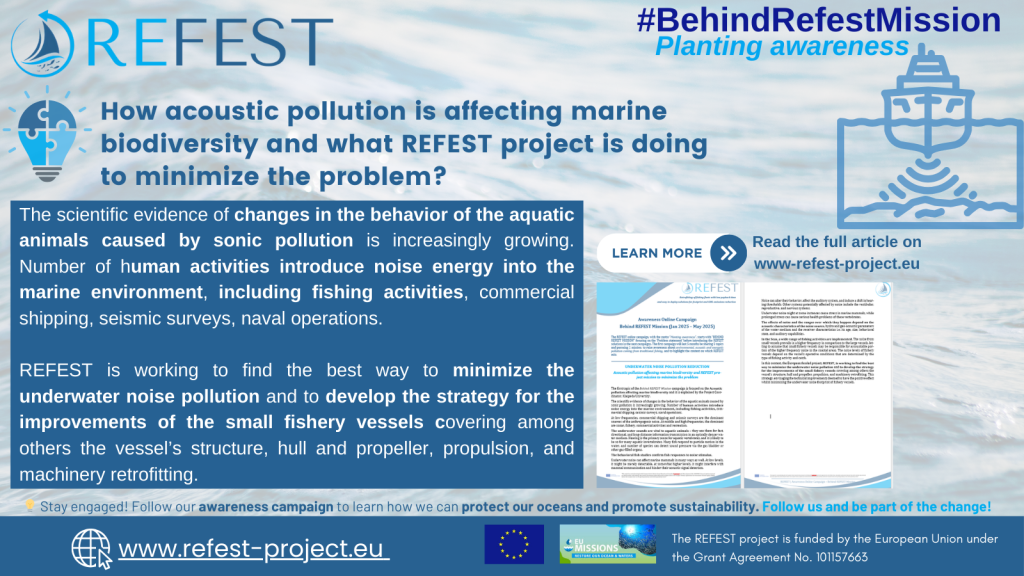
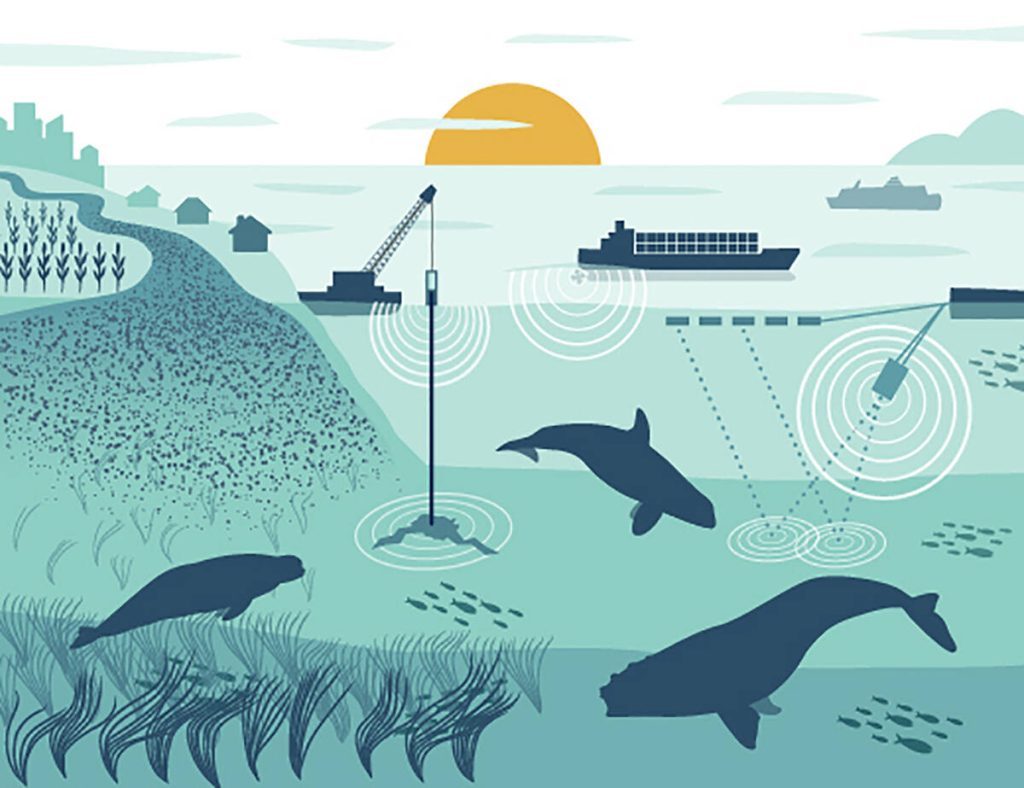
The scientific evidence of changes in the behavior of the aquatic animals caused by sonic pollution is increasingly growing. Number of human activities introduce noise energy into the marine environment, including fishing activities, commercial shipping, seismic surveys, naval operations.
At low frequencies, commercial shipping and seismic surveys are the dominant sources of the anthropogenic noise. At middle and high frequencies, the dominant are sonar, fishery, commercial activities and recreation.
The underwater sounds are vital to aquatic animals – they use them for fast, directional, and long-distance information transmission in an optically denser water medium. Hearing is the primary sense for aquatic vertebrates, and it is likely to be so for many aquatic invertebrates. Many fish respond to particle motion in the water, and number of species can detect sound pressure via the gas bladder or other gas-filled organs.
The behavioral fish studies confirm fish responses to noise stimulus.
Underwater noise can affect marine mammals in many ways as well. At low levels, it might be merely detectable, at somewhat higher levels, it might interfere with mammal communication and hinder their acoustic signal detection.
Noise can alter their behavior, affect the auditory system, and induce a shift in hearing thresholds. Other systems potentially affected by noise include the vestibular, reproductive, and nervous systems.
Underwater noise might at some instances cause stress in marine mammals, while prolonged stress can cause serious health problems of these vertebrates.
The effects of noise and the ranges over which they happen depend on the acoustic characteristics of the noise source, hydro and geo-acoustic parameters of the water medium and the receiver characteristics i.e. its age, size, behavioral state, and auditory capabilities.
In the Seas, a wide range of fishing activities are implemented. The noise from small vessels prevails in a higher frequency in comparison to the large vessels, letting to assume that small fishery vessels may be responsible for accountable portion of the higher frequency noise in the coastal areas. The noise levels of fishery vessels depend on the vessel’s operative conditions that are determined by the type of fishing activity and catch.
In this context, the European funded project, REFEST, is working to find the best way to minimize the underwater noise pollution and to develop the strategy for the improvements of the small fishery vessels covering among others the vessel’s structure, hull and propeller, propulsion, and machinery retrofitting. This strategy, envisaging the technical improvements deemed to have the positive effect whilst minimising the underwater noise footprint of fishery vessels.
Download the full article from the ”Download‘ page.
Cover image by Hal Gatewood on Unsplash