

The REFEST online campaign, under the motto “Planting Awareness,” kicks off with “BEHIND THE REFEST MISSION”, focusing on the Problem Statement. This campaign will introduce the challenges we face before presenting the REFEST solutions in upcoming campaigns. The first campaign will span 5 months, covering 5 key topics and pursuing one main goal: to raise awareness about the environmental, acoustic, and energy pollution caused by traditional fishing practices, while shedding light on the context in which REFEST operates. Learn more about it int he dedicated news!
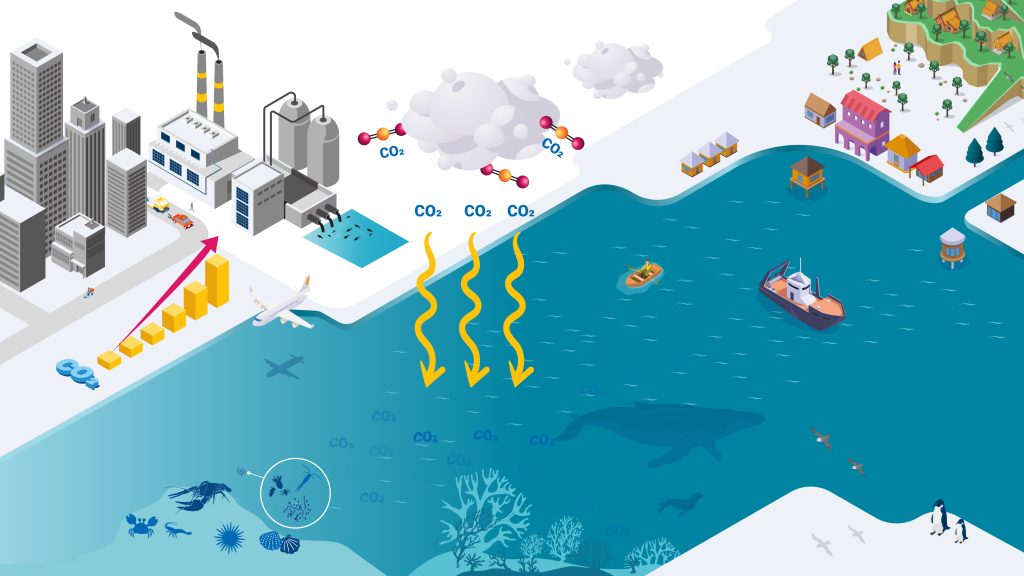
Image – Ph. IAEA (https://www.iaea.org/bulletin/how-carbon-emissions-acidify-our-ocean)
2° TOPIC: REDUCTION OF CO2 AND OTHER POLLUTANT EMISSIONS
The second topic of the Behind REFEST Mission campaign is focused on thereduction of CO2 and other pollutant emissions and it is explained by the Project Coordinator, Klaipeda University, with the Project Partner, MORSKI INSTYTUT RYBACKI – PAŃSTWOWY INSTYTUT BADAWCZY (MIR).
The effects of global warming and the negative impacts of air pollutants, such as nitrogen oxides, are well known. Global efforts are underway to reduce greenhouse gases and harmful pollutants across all sectors, including transportation, specifically global shipping. Global shipping consumes between 200 to 400 million tons of fuel annually, significantly contributing to air pollution and greenhouse gas emissions. An internal combustion engine using diesel fuel produces around 3.19 kg of CO2 per kilogram of fuel used. Emissions of other pollutants, such as nitrogen oxides and particulate matter, are also associated with engine operation and can vary widely.
Fishing vessels are no exception, they use internal combustion engines and emit CO2 and other toxic pollutants. Although fishing vessels represent a small fraction compared to commercial cargo vessels, most emissions occur close to shore, in densely populated areas where the effects of toxic pollutants are more significant.
The greenhouse gas effect is well known. The Earth’s surface temperature varies depending on the atmosphere’s permeability to infrared radiation. The atmosphere acts as a selective filter, reflecting, scattering, allowing, and absorbing different amounts of solar radiation.
Certain gases like CO2, N2O, H2O, CH4, and CFCs, known as greenhouse gases, can absorb infrared radiation. When solar radiation reaches and is absorbed by the Earth’s surface, about 40-50% of the solar radiation heats the surface, which then radiates the absorbed heat back in the IR (Infrared radiation) range. In this process, the Earth’s surface acts as a converter of electromagnetic radiation wavelengths. The energy radiated as IR gets trapped in the greenhouse gases, with some of the energy returning to the Earth’s surface, ultimately increasing the surface temperature.
The REFEST project aims to develop the strategy for the improvements of the small fishery vessels covering among others the vessel’s structure, hull and propeller, propulsion, and machinery retrofitting to reduce greenhouse gas emissions up to 40% and achieve a much cleaner climate friendly operation.
Acronyms:
- CO2 – Carbon dioxide
- N2O – Nitrous oxide
- H2O – The chemical symbol for water. Each molecule of water contains two atoms of hydrogen (H) joined to a single atom of oxygen (O)
- CH4 – Methane
- CFC – Chlorofluorocarbon
Download the full article from the ”Download‘ page.
Cover image by Nikldn on Unsplash